Transplant Coordinators: A Key Link in the Donation-to-Transplant Journey Impact of MOHAN Foundation's Trained Transplant Coordinators
Sujatha Suriyamoorthi
Indian Transplant Newsletter. 2026 Jan-Mar; 25(1):p1-2
DOI: https://doi.org/10.64384/ITN.2026.015
Print ISSN 0972 - 1568
Online ISSN 3048 - 653X
Download PDF
Every successful organ transplant is the outcome of the coordinated efforts of a multidisciplinary healthcare team, with transplant coordinators serving as one of the key links in the donation-to-transplant journey. Acting as a bridge between healthcare professionals, hospital administration, regulatory authorities, donor families, recipients, and other stakeholders, transplant coordinators must bring compassion, effective communication, sound clinical knowledge, meticulous coordination, and the ability to manage emotionally and physically challenging situations while upholding ethical and legal standards.
Recognising their importance, the 2011 amendments to the Transplantation of Human Organs Act made it mandatory for every hospital in India seeking registration as a transplant centre, retrieval centre or tissue bank to appoint a trained transplant coordinator. Even before this legal provision was introduced, to address the need for skilled transplant coordinators, MOHAN Foundation initiated comprehensive, structured training programmes in 2009. The training curriculum covers the medical, legal, ethical and religious aspects as well as grief counselling and transplant coordination.
Between December 2009 and June 2026, MOHAN Foundation conducted 127 Transplant Coordinators' Training Programmes of varying durations, including 73 face-to-face and 54 online programmes. The face-to-face training programmes were conducted across multiple states in India and one in Bangladesh, with a total of 5,054 individuals trained. The Foundation's flagship week-long Transplant Coordinators' Training Programme was later adopted by the National Organ and Tissue Transplant Organization (NOTTO) and 28 such programmes were conducted under the aegis of NOTTO. In addition to NOTTO, the training programmes were also conducted in collaboration with bodies such as Armed Forces Organ Retrieval & Transplantation Authority (AORTA), Fortis Organ Retrieval & Transplant (FORT) and Society of Transplantation, Bangladesh. The one-year online programme, Post-Graduate Diploma in Transplant Coordination and Grief Counselling, was recognised as one of the top three finalists for the BMJ South Asia Award in 2018.
In December 2025, MOHAN Foundation was recognized as a training provider by the CPD Standards Office, United Kingdom and its short-term and long-term online training programs for transplant coordinators received CPD accreditation.
In 2010, MOHAN Foundation signed a pilot project with Rajiv Gandhi Government General Hospital (RGGGH), Chennai, to strengthen the hospital's deceased organ donation programme by placing trained transplant coordinators at no cost. These coordinators worked closely with the intensive care team, counselling grieving families and coordinating deceased organ donation.
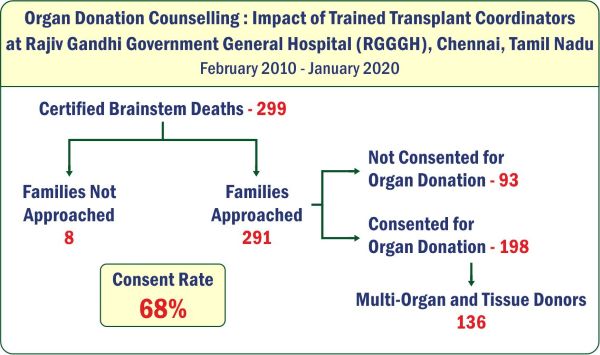
Between February 2010 and January 2020, 299 patients were certified as brainstem dead at RGGGH. When approached, 198 out of 291 families consented to donate their loved ones’ organs with an impressive 68% consent rate (Image 1). A total of 136 multi-organ donations were coordinated, resulting in the retrieval of 854 organs and tissues. The inclusion of transplant coordinators led to successful outcomes, with the hospital contributing 11% of Tamil Nadu's deceased organ donations during the period.
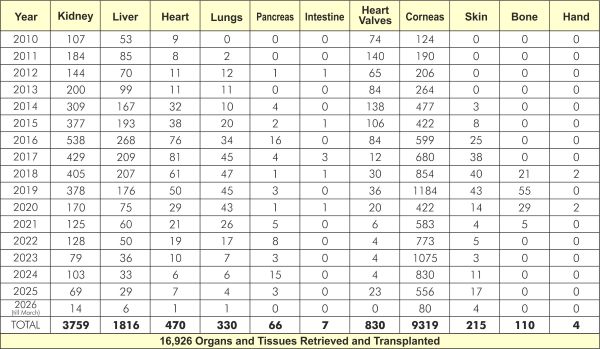
This success led to the placement of transplant coordinators in other government hospitals in Tamil Nadu as well as at various public and private hospitals in seven other states including some in the Northeast. Many other trained transplant coordinators were subsequently employed by transplant centres across the country. Follow-up data from February 2010 to March 2026 indicate that these transplant coordinators contributed to the donation of more than 16,900 organs and tissues, saving thousands of lives and improving the quality of life of recipients (Table 1).
Beyond deceased donation, these coordinators also play a vital role in creating awareness, coordinating living donor transplant programmes, facilitating legal documentation and approvals, counselling recipients, coordinating transplant procedures and post-transplant follow-up.
It is evident that transplant coordinators are integral to the success of every transplant programme. Working closely with patients, families, and multidisciplinary healthcare teams, they serve as a vital liaison throughout the donation and transplantation process. Structured training that emphasizes clinical knowledge, communication skills, empathy, and ethical practice equips transplant coordinators to support patients and families effectively, foster trust in the healthcare system, and contribute to improved donation rates and transplant outcomes.
To cite
: Suriyamoorthi S. Transplant Coordinators: A Key Link in the Donation-to-Transplant Journey Impact of MOHAN Foundation's Trained Transplant Coordinators. Indian Transplant Newsletter. 2026 Jan-Mar; 25(1):p1-2.
DOI: 10.64384/ITN.2026.015
Available at:
https://www.itnnews.co.in/indian-transplant-newsletter/issue80/Transplant-Coordinators-A-Key-Link-in-the-Donation-to-Transplant-Journey-Impact-of-MOHAN-Foundations-Trained-Transplant-Coordinators-1454.htm
Available at:
https://www.itnnews.co.in/indian-transplant-newsletter/issue80/Transplant-Coordinators-A-Key-Link-in-the-Donation-to-Transplant-Journey-Impact-of-MOHAN-Foundations-Trained-Transplant-Coordinators-1454.htm
- Copyright © 2026. Published by MOHAN Foundation
