Living Donation and Minors: Balancing Policy and the Best Interests of the Child(Discussing with Recent Judgements)
Prashant Ajmera, Advocate, Co-Founder - OneIndiaOnelaw.org
Indian Transplant Newsletter. 2026 Apr-June; 25(2):p3-5
DOI: https://doi.org/10.64384/ITN.2026.016
Print ISSN 0972 - 1568
Online ISSN 3048 - 653X
Download PDF
Introduction
Organ donation by a minor is one of the most legally sensitive corners of transplant medicine in India. The statute permits it only in exceptional circumstances, the rules impose strict conditions, and Authorisation Committees — the bodies actually empowered to decide such cases — have, in practice, developed a strong institutional reluctance to grant permission at all.
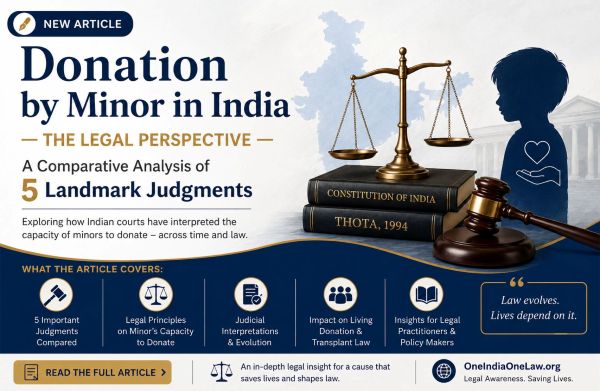
In this article, three provisions that govern the field are discussed — Section 2(hb), Section 9(1B) of the Transplantation of Human Organs and Tissues Act, 1994 (THOTA), and Rule 5(3)(g) of the Transplantation of Human Organs and Tissues Rules, 2014 (1) — along with how courts have actually applied them, and why the common belief that "courts decide" these cases needs correction.
The Three Provisions
1. Section 2(hb) — Definition of "minor"
The THOTA Act defines the term plainly: a minor is "a person who has not completed the age of eighteen years." This definition was inserted by the 2011 amendment to the Act and is the threshold that triggers every other protective provision discussed below.
2. Section 9(1B) — The substantive bar
Section 9 of THOTA deals broadly with restrictions on removal and transplantation of organs. Sub-section (1B), inserted by the same 2011 amendment, is the operative clause for minor donors. In substance, it prohibits removing any organ or tissue from a living minor for transplantation, "except in the manner as may be prescribed" by Rules. In other words, the Act does not impose an absolute prohibition — it delegates the actual conditions of permission to subordinate legislation, which is where THOTA Rules 2014 Section 5(3)(g) comes in.
3. Rule 5(3)(g) of the 2014 Rules — The operative test
This is the provision that Authorisation Committees, hospitals, and courts actually apply while examining a minor's case. It provides that living organ or tissue donation by a minor is not permitted "except on exceptional medical grounds to be recorded in detail with full justification," and — critically — this exception requires prior approval not merely of the Appropriate Authority but also of the State Government concerned. This dual sign-off requirement makes minor-donor cases procedurally heavier than ordinary near-relative donations, which need only Authorisation Committee approval.
Read together, these three provisions create a narrow, tightly conditioned gateway: a minor can be a living donor only when (a) no adult near relative is medically suitable, (b) the medical case is genuinely exceptional, (c) the reasoning is documented in detail, and (d) both the Appropriate Authority and the State Government have signed off — not the Authorisation Committee alone.
The Practical Problem:
Authorisation Committees Choose to Say No
On paper, Rule 5(3)(g) is an exception clause, not a prohibition. In practice, many Authorisation Committees across India treat it as a prohibition. Faced with a minor-donor file, many committees either reject the application outright or — more commonly — simply record that "donation under 18 is not permitted," without engaging with whether the specific medical facts before them qualify as an "exceptional ground" under the Rules.
This is not a hypothetical concern. It was the subject of considerable discussion at a transplant-law conference following a High Court ruling on organ donation involving a minor, where practitioners repeatedly framed the issue as one of "getting the High Court to decide" a minor's case — a framing, this article specifically wants to correct.
The reasons for this institutional caution are understandable: Authorisation Committees operate under the shadow of Sections 19 and 19A of the Act, which criminalise commercial dealings in organs, and members are conscious that any error in a minor's case — medical or otherwise — carries reputational and legal exposure for the committee itself. But caution has, in a meaningful number of cases, curdled into a blanket refusal to even examine whether "exceptional medical grounds" are met — which is itself an abdication of the discretionary function Rule 5(3)(g) actually vests in these bodies.
What Courts Actually Do — And What They Do Not Do
This is the point that most needs to be said plainly to medical professionals following these cases through media coverage: High Courts and the Supreme Court do not, as a rule, decide minor organ donation cases on facts. Their constitutional function is to interpret the law — Section 9(1B), Rule 5(3)(g), and related provisions — and then examine whether the Authorisation Committee's order, when tested against that interpretation, can stand. In the overwhelming majority of reported cases, the result of a successful writ petition is that the impugned order is set aside and the matter is sent back to the very same Authorisation Committee, now directed to decide afresh, in light of the law as clarified by the Court, and usually within a fixed timeline.
Two illustrations from recent unrelated-donor jurisprudence (governed by a parallel provision, Section 9(3), but decided on the same institutional logic) make the pattern clear:
- In Sudha Mathesan vs The Authorisation Committee on 30 May, 2024 (2), the Madras High Court did not itself approve the kidney donations in question. It "directed the Authorisation Committee to scrutinise the applications within four weeks" — the Court corrected the legal approach the Committee was required to take, and then returned the decision to the Committee.
- In Dr. J. Kaja Moinudeen vs The Authorisation Committee on 9 October, 2023 (3), the Madras High Court similarly declined to grant the NOC. It "directed the Authorisation Committee to either approve the application or reject it" under the statutory sub-sections governing that decision.
This is the ordinary pattern for minor-donor cases as well: the Court interprets Section 9(1B) and Rule 5(3)(g), examines whether the Committee's reasoning (or absence of reasoning) is legally sustainable, and — in most cases — remits the file back to the Committee rather than substituting its own judgement on the medical facts.
In a case where the proposed living donor was a minor and did not fall within the definition of a 'near relative', and the Authorisation Committee had rejected the application without providing reasons, the Court directed the Appellate Authority to consider and determine the matter in accordance with law.
- In Arvind Subash Singh vs Director of Health Services (4), the Bombay High Court rejected the KEM Hospital's first response — "a cryptic report without furnishing any reasons," merely reproducing statutory text, which directed the Appellate Authority under Section 17 of the Act to hear the petitioners and report back within twenty-four hours. The Appellate Authority reversed the rejection, describing its approval as "a special and rare case," valid for six months; the writ petition, the Court noted, had thereby "worked itself out." The Bench made no independent finding on donor fitness or risk — it policed the process and enforced compliance once the Act's ownappellate mechanism had ruled.
This reinforces a point worth stating plainly: the Court does not take away the Authorisation Committee's (or Appellate Authority's) power to approve or reject a case. It only requires that body to decide the case correctly — applying the right interpretation of the law to the actual facts before it — rather than substituting its own judgement for theirs.
The rare exception.
Only in a limited category of cases — typically where a life is at immediate risk, the medical evidence of "exceptional grounds" is undisputed on record, and a remand would itself cause fatal delay — does a court invoke its extraordinary writ jurisdiction under Article 226 (or Article 32) to grant permission directly, effectively stepping into the shoes of the Authorisation Committee. Two recent examples show this rare exception in action:
- In Pratik Shaw vs Union of India, 2026 (5), the Delhi High Court permitted a 17-year-old to donate part of his liver to his father directly, rather than remitting the matter, because the medical urgency was undisputed, the State Government and Appropriate Authority had already granted approval by letter dated 29 June 2026, and further delay could "lead to loss of the petitioner's father's life.”
- In Minor Atonu Saha vs The State of Tamil Nadu on 29 May, 2026 (6), the Madras High Court set aside a Tamil Nadu Authorisation Committee order refusing a mother's donation of her kidney to her minor son, holding that the Committee's reasoning "suffered from misdirection in law and non-application of mind," and directed immediate grant of permission rather than sending the matter back — again because the medical urgency and documentary proof of relationship were not seriously in dispute.
Both are exceptions that prove the rule: courts step into the decision-making seat only when remand itself would be an empty formality that risks a life. The default constitutional posture remains interpretation of law followed by remand the statutory body entrusted by the Parliament with making the decision — the Authorisation Committee.
Why This Distinction Matters for Medical Professionals
Media coverage of these judgements tends to compress a careful, often lengthy judicial reasoning process into a headline — "Court allows minor to donate organ." This flattens an important distinction that this article wants to underline: in most cases, the Court is not pronouncing on whether this particular child should donate; it is pronouncing on whether the Committee's legal approach to Section 9(1B) and Rule 5(3)(g) was sound, and then handing the actual medical-and-equitable judgement back to the Committee.
Several of these judgments are, frankly, substantial pieces of legal reasoning — written by some of the finest legal minds sitting on Indian High Courts — that trace the legislative history of the 2011 amendment, the WHO Guiding Principles that influenced it, and the constitutional balance between individual autonomy, parental consent, and the State's protective interest in a minor's bodily integrity. Reading only the headline, or a two-line media summary, does a disservice both to the Court's reasoning and to the practitioners who will need to rely on that reasoning the next time a similar file crosses an Authorisation Committee's desk.
Medical professionals, hospital legal teams, and Authorisation Committee members are strongly encouraged to read the full text of judgements such as Pratik Shaw vs Union of India and Atonu Saha vs State of Tamil Nadu — not merely the press summaries — to properly understand both the narrow circumstances in which "exceptional medical grounds" under Rule 5(3)(g) were found to be made out, and the far more common circumstance in which a court's role begins and ends with correcting the Committee's legal approach and returning the file for a reasoned decision.
Conclusion
The statutory architecture — Section 2(hb)'s definition, Section 9(1B)'s substantive bar, and Rule 5(3)(g)'s conditional exception — is deliberately narrow and deliberately discretionary. That discretion was vested in Authorisation Committees, not in courts. When Committees decline to exercise that discretion at all, or treat the exception as a nullity, they invite exactly the kind of judicial correction seen in the cases above. But that correction, in the ordinary course, sends the decision back to where the law placed it — not to the High Court. Only genuine, undisputed urgency moves a court to decide the case itself. Practitioners who understand this distinction will be far better placed to prepare a minor-donor file that actually engages with what Rule 5(3)(g) requires, rather than treating a High Court petition as an alternative pathway to a decision the Authorisation Committee itself should have made.
This article is intended for general informational purposes for medical and legal professionals working with the Transplantation of Human Organs and Tissues Act, 1994, and the Transplantation of Human Organs and Tissues Rules, 2014. It does not constitute legal advice. Readers handling an actual minor-donor case should consult the full text of the Act, the Rules, and the judgments cited, and take independent legal counsel.
References
1. https://notto.mohfw.gov.in/act-and-rules-THOA
2. https://indiankanoon.org/doc/163981439/
3. https://indiankanoon.org/doc/155225322/
4. https://indiankanoon.org/doc/196926755/
5. Pratik Shaw Minor v. Union of India, 2026 SCC OnLine Del 4834,
decided on 29-6-2026
6. https://indiankanoon.org/doc/9936145/
To cite
: Ajmera P. Living Donation and Minors: Balancing Policy and the Best Interests of the Child(Discussing with Recent Judgements). Indian Transplant Newsletter. 2026 Apr-June; 25(2):p3-5.
DOI: 10.64384/ITN.2026.016
Available at:
https://www.itnnews.co.in/indian-transplant-newsletter/issue80/Living-Donation-and-Minors-Balancing-Policy-and-the-Best-Interests-of-the-ChildDiscussing-with-Recent-Judgements-1455.htm
Available at:
https://www.itnnews.co.in/indian-transplant-newsletter/issue80/Living-Donation-and-Minors-Balancing-Policy-and-the-Best-Interests-of-the-ChildDiscussing-with-Recent-Judgements-1455.htm
- Copyright © 2026. Published by MOHAN Foundation
