Saving a Stranger, Fighting the System: A Doctor’s Journey
Thankam Subramonian
Indian Transplant Newsletter. 2026 Jan-Mar; 25(1): p.6-7
DOI: https://doi.org/10.64384/ITN.2026.011
Print ISSN 0972 - 1568
Online ISSN 3048 - 653X
Download PDF
What inspired you to consider altruistic organ donation? Was there a defining moment behind this decision?
There was no particular “Eureka” or defining moment. The thought had been at the back of my mind for a very long time. Around 2014, I signed up for deceased organ donation. I carried my donor card with me at all times and spoke about it whenever possible to spread awareness.
Gradually, I began to realize that despite doing everything from my side, actual donation cannot take place without multiple things falling into place and many conditions being met. In reality, the conversion from organ pledging to actual organ donation remains very low.
This led me to question—Is signing up and carrying a donor card really enough? It may or may not ever come to fruition. How can one ensure that one's wish to donate organs is truly respected and fulfilled? Once a person is no longer alive, their autonomy ceases, and circumstances begin to dictate decisions. That realization struck me deeply. Why leave such an important decision to circumstances or to chance?
So, in 2016, I decided that I would donate while I was still alive. It felt like a way to exercise my autonomy fully. The only organ I could donate as a living donor was a kidney—and that is the path I chose.
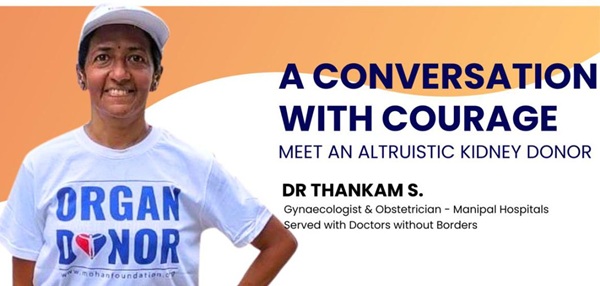
As a medical professional, how did your clinical knowledge influence your personal decision to donate? Did it make the choice easier or more complex?
The decision to donate was independent of my being a doctor, though my medical background did make the process easier. Once I made up my mind, I began doing my homework—speaking with fellow doctor friends and consulting nephrologists. I also reached out to the transplant team at my hospital to understand, in detail, the possible risks and side effects involved. I came to realize that living kidney donation is a safe procedure—the real challenge lay in overcoming the emotional barrier. At heart, I would describe myself as somewhat adventurous, with a relatively high threshold for fear. All of these factors, taken together, ultimately led me to my final decision to proceed with living kidney donation.
How did you approach the conversation with your family about your decision to donate, and what was their reaction?
When I first spoke to my family about my decision to donate, obviously there was a setback. They couldn't understand why I would take such a drastic step. Naturally, they were strongly opposed and suggested alternative ways of helping others, such as setting up a trust, raising funds through friends and family, and supporting needy patients.
However, I was clear about my intent. I felt strongly about promoting organ donation through action, not just words or money. In a country like India, which has one of the lowest organ donation rates despite its large population, I felt the need to lead by example rather than simply advocate for it.
These conversations with my family were not easy and often repeated over time. There were moments when the topic was avoided altogether. Around this period, I was also involved in humanitarian work, including assignments with Doctors Without Borders in Yemen and Afghanistan, and participation in a COVID-19 vaccine trial. My family was aware that I tend to take unconventional paths and eventually stood by my decisions, even when some level of risk was involved.
Over time, their resistance became less apparent. To my children, personal autonomy is important and so, supported my right to make decisions about my own body. As they matured and became independent thinkers, my kids (and the rest of my family) gave their 'No Objection Certificate' while at the same time maintaining that it was a 'crazy idea' which they themselves would never undertake. I truly believed that when my intention was sincere and the cause meaningful, they would eventually understand me and circumstances would align to support the journey. And they did.
What were the key challenges you encountered within the regulatory system during your donation journey?
Nobody had ever done a non-directed living donation in the State of Karnataka, though a handful of altruistic donations have been cited in Kerala and Maharashtra. What I believed would be a simple act of kindness turned out to be unexpectedly difficult. Whenever I was asked, “Whom are you donating to?”, my answer was always, “I do not know.” The reactions often carried an unspoken assumption: this woman must be crazy.
No one seemed certain about how to handle such a case or what the procedure even was. I began knocking on countless doors, searching for guidance and clarity.
What followed was a maze of paperwork, documentation, and endless verifications. Every office presented a new hurdle—police checks, home visits, repeated questioning, and constant scrutiny. At one point, I was even told that no such process existed. Looking back and sharing it now may make it seem as though everything happened quickly, but this journey unfolded over several years (2016 to 2026).
Working within the system — how did you manage to push through these challenges?
My file was placed before the Hospital Based Authorization Committee for the first time in March 2023, after around 7 years of start of my journey towards altruistic kidney donation. A 24-year-old man from the 'deceased donor waitlist' was identified as the recipient, as I was found to be a match for him. The interview with the committee was long and intense. While they were sympathetic to my narrative, they were thorough- they questioned my decision, my fitness, and the extent of my family's involvement and support. However, at the end of it all, the committee denied permission because I was unrelated to recipient—defeating the purpose of altruism.
That was the point I felt whether I had reached the end of the road and was deeply discouraged. I did not know what to do or how to move on. For almost a year, I stopped trying to take any further action. Later, during an incidental visit to the Nephrology Department, I came to know that the potential recipient (to whom I might have donated my kidney to, had the committee granted permission), had died without receiving a transplant. I was heartbroken. I kept asking myself: Why did I accept the decision without fighting it? Why did I give up hope?
People supporting me tried to comfort me, reminding me that we had done everything within our control. I did not want to give up. I felt morally responsible to continue and was determined to keep pushing forward. I returned with renewed determination and vigour. Conversations with several experts eventually made one thing clear: if I truly wanted to pursue this, I would have to knock on the doors of the law. Dr. H. Sudarshan Ballal, the transplant head, Manipal Hospitals, Bengaluru was my biggest support, and he kept helping me navigate the process one step at a time. Dr. Joga Rao, my advocate, unstintingly stood by me and represented me in the court, and fought the case pro bono.
What are your views on the ethical considerations and regulatory framework surrounding non-directed altruistic organ donation in India?
Looking back, I do not think the system was entirely at fault. The fear of misuse and fraud is real, and strict checks are necessary for a reason. If the process becomes too easy, it could be misused and create serious problems.
At the same time, I realized that the law does not prohibit non-directed donation. The real gap lies in awareness and transparency. People need to know that non-directed donation is possible, and there should be more public discussion about it so both society and regulatory authorities can approach it with greater openness. The regulatory system should also recognize this opportunity and develop clear systems and protocols for all stakeholders involved.
What changes would you suggest to make the process more transparent and accessible?
Start with public awareness: one deceased donor can save many lives. Death is still a social taboo, and even raising the subject can feel uncomfortable. Normalize home conversations about death/wishes. Government events and the media should spread awareness that it is safe and necessary.
I do not want my act to remain a one-off story but to become part of a wider shift in awareness, supported by public events, stronger communication, and more responsible media coverage
Non-directed altruistic organ donor - How has this journey changed you—both as a doctor and as an individual?
As a doctor, not much change—I am planning my next MSF mission post-recovery….but is still too early. But as a human being, I feel more gratitude in my heart for having been given the opportunity to do this. I also feel more responsible, to spread awareness about organ donation and more daring.
I speak more openly now about living donation and the importance of being healthy if one wants to be a potential donor. My lifestyle was already healthy, so the journey reinforced rather than transform my habits. I have always been conscious about my nutrition, exercise, yoga, running etc. I now remain even more mindful about protecting my health and fitness.
When the committee first rejected the application, my family quietly felt relieved. In a way, they no longer had to oppose my decision because the committee had already said 'No'. But later, when things changed, the transformation in my family was remarkable—especially in my brother. He flew from the US on the day of my surgery and became one of my strongest pillars of support. He even created a website, “One Donor Many Lives,” where people can learn about my journey and access reliable information about organ donation and transplantation. In the end, my family fully supported me and helped me walk through this journey with courage.
Emotionally, the biggest change is a deep sense of contentment. Seeing the recipient well and full of life has brought me immense happiness.
For more information about the inspiring journey of
Dr. Thankam Subramonian,
please visit: www.onedonormanylives.com
To cite
: Subramonian T. Saving a Stranger, Fighting the System: A Doctor’s Journey. Indian Transplant Newsletter. 2026 Jan-Mar; 25(1): p.6-7.
DOI: 10.64384/ITN.2026.011
Available at:
https://www.itnnews.co.in/indian-transplant-newsletter/issue79/Saving-a-Stranger-Fighting-the-System-A-Doctors-Journey-1450.htm
Available at:
https://www.itnnews.co.in/indian-transplant-newsletter/issue79/Saving-a-Stranger-Fighting-the-System-A-Doctors-Journey-1450.htm
- Copyright © 2026. Published by MOHAN Foundation
