Not Euthanasia: A Family that Chose Dignity: The Real Story of Harish Rana
Srinagesh Simha, Raj Kumar Mani, Roopkumar Gursahani
Indian Transplant Newsletter. 2026 Jan-Mar; 25(1): p.10-11
DOI: https://doi.org/10.64384/ITN.2026.013
Print ISSN 0972 - 1568
Online ISSN 3048 - 653X
Download PDF
In August 2013, Harish Rana was a 19-year-old engineering student at Panjab University, Chandigarh. He fell from the fourth floor of his hostel, sustaining a diffuse axonal brain injury that left him with 100% quadriplegia and Permanent Vegetative State (PVS). He never regained consciousness.
For over a decade his family cared for him at their home in Ghaziabad. He was kept alive through a tracheostomy tube for breathing and a Percutaneous Endoscopic Gastrostomy (PEG) tube for nutrition and hydration, Clinically Assisted Nutrition and Hydration (CANH). Every medical review reached the same conclusion: irreversible. No chance of recovery.
His parents, Ashok and Nirmala Rana, never left his side. When they finally petitioned the courts, it was not from giving up. It was from love a wish to let their son leave with the dignity his condition had stripped away.
The Delhi High Court rejected the petition in 2024, ruling that withdrawing a feeding tube would constitute starvation, not medical withdrawal. The family appealed to the Supreme Court. On 11 March 2026, a bench of Justices J.B. Pardiwala and K.V. Viswanathan allowed the withdrawal of treatment and directed Harish's transfer to AIIMS palliative care. He passed away on 24 March. His family donated his corneas and heart valves.
What the Supreme Court decided
The judgment resolved two questions that had been unanswered since the 2018 Common Cause framework.
Is CANH a medical treatment? Yes. The Court held that a PEG feeding tube requiring surgical insertion, clinical monitoring, and professional judgement is a medical intervention, not basic care. It can be withdrawn when it no longer serves the patient's best interests.
Who decides without a Living Will? The Court applied a best-interest standard. With both Medical Boards and the family in unanimous agreement, it held that withdrawal served Harish's best interests and waived the standard 30-day waiting period.
The Court also directed that withdrawal must not mean abandonment; Harish was to receive structured palliative care at AIIMS throughout. And, it called on Parliament, again, to enact comprehensive end-of-life care legislation.
The misconception: why “passive euthanasia” is the wrong term
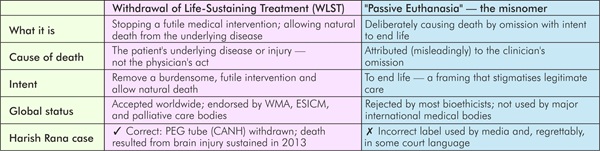
The term “passive euthanasia” entered Indian judicial language years ago and made popular in the Aruna Shanbaug (2011) judgment and has been carried forward ever since. It is not used by the World Medical Association, the European Society of Intensive Care Medicine, or major palliative care bodies internationally because they are two fundamentally different acts.
Euthanasia implies an intent to cause death. Withdrawal of life-sustaining treatment means removing a futile intervention and allowing the patient to die from their underlying condition. In this case, the cause of death was a brain injury sustained in 2013 not a decision made in 2026.
Using the wrong label has real consequences. It deters clinicians from withdrawing futile treatment. It misrepresents the cause of death. It complicates organ donation conversations. And it makes it harder for Parliament to draft clear, workable legislation. The medical community must use and advocate for the correct terminology: Withdrawal of Life-Sustaining Treatment.
Why it matters for transplant and critical care
Living Wills: Harish had no Advance Medical Directive. The Court urges integration of Living Wills into the Ayushman Bharat Health Account (ABHA) system, which already has 79 crore accounts. Until this is routine, families will keep navigating these decisions without the patient's own voice.
Organ donation: The Rana family's decision to donate Harish's corneas and heart valves is a reminder that end-of-life care and donation are not competing. But, donation discussions must remain strictly separate from withdrawal decisions to protect trust.
Palliative care: The Court's insistence on structured palliative care during withdrawal is a moral directive. Few states have constituted the Medical Boards that the 2023 guidelines require. Private hospitals still avoid the protocol for fear of litigation. This must change.
Closing
Harish Rana's family spent 13 years caring for him with extraordinary love. When they sought withdrawal of treatment, they were acknowledging a death that had, in every meaningful sense, already occurred, and asking that medicine step back with grace. The Supreme Court was right to allow it.
What it called that act, however, matters. Passive euthanasia is the wrong name for what happened. Getting the name right is not pedantry it is the foundation on which every future family, clinician, and legislator will build their decisions.
Acknowledgment: Claude AI tool was used to compress the resources and the authors have reviewed and edited the contents The authors thank Ms Mithili Sherigar for technical assistance.
In their own words
“You are not giving up on your son. You are allowing him to leave with dignity. It reflects the depth of your selfless love and devotion towards him.”
- Justice J.B. Pardiwala, Supreme Court of India, 11 March 2026
“The right to die with dignity is inseparable from the right to receive quality palliative and end-of-life care.”
- Supreme Court of India, Harish Rana v. Union of India, 2026
“When primary and secondary boards have certified withdrawal of life support, there is no need for judicial intervention.”
- Supreme Court of India, Harish Rana v. Union of India, 2026
“The prolonged absence of comprehensive legislation on end-of-life care has compelled this Court, time and again, to step in to fill the vacuum.”
- Supreme Court of India, Harish Rana v. Union of India, 2026
“Withdrawing life support will not bring us any personal benefit. We only want to restore Harish's dignity after years of irreversible suffering.”
- Ashok Rana, Harish's father
“Harish Rana also donated five organs as he left the world. He became an inspiration to the world.”
- Ajay Rai, at the final rites of Harish Rana
REFERENCES
1. Harish Rana v. Union of India, Supreme Court of India, 11 March 2026, Justices J.B. Pardiwala and K.V. Viswanathan.
2. Common Cause v. Union of India, (2018) 5 SCC 1.
3. Aruna Ramchandra Shanbaug v. Union of India, (2011) 4 SCC 454.
4. World Medical Association. WMA Statement on Physician-Assisted Dying. 2019.
5. Truog RD, et al. Recommendations for end-of-life care in the ICU. Crit Care Med. 2008;36(3):953–963.
6. Sengupta R. Dignity at the End. Verfassungsblog. 2026 Mar 28. DOI: 10.59704/f81589d5036f8434.
7. Law Commission of India. 241st Report on Passive Euthanasia – A Relook. 2012.
To cite
: Simha S, Mani RK, Gursahani R. Not Euthanasia: A Family that Chose Dignity: The Real Story of Harish Rana. Indian Transplant Newsletter. 2026 Jan-Mar; 25(1): p.10-11.
DOI: 10.64384/ITN.2026.013
Available at:
https://www.itnnews.co.in/indian-transplant-newsletter/issue79/Not-Euthanasia-A-Family-that-Chose-Dignity-The-Real-Story-of-Harish-Rana-1452.htm
Available at:
https://www.itnnews.co.in/indian-transplant-newsletter/issue79/Not-Euthanasia-A-Family-that-Chose-Dignity-The-Real-Story-of-Harish-Rana-1452.htm
- Copyright © 2026. Published by MOHAN Foundation
