India's Uneven but Encouraging Progress in Deceased Organ Donation
Sunil Shroff
Indian Transplant Newsletter. 2026 Jan-Mar; 25(1): p.1 and11
DOI: https://doi.org/10.64384/ITN.2026.001
Print ISSN 0972 - 1568
Online ISSN 3048 - 653X
Download PDF
India has emerged as a global leader in living donor kidney and liver transplantation. Thousands of patients every year receive a second chance at life through the generosity of living donors and the high level of expertise of Indian transplant teams. Yet, when it comes to deceased organ donation, the country's progress, though encouraging, remains modest and uneven.
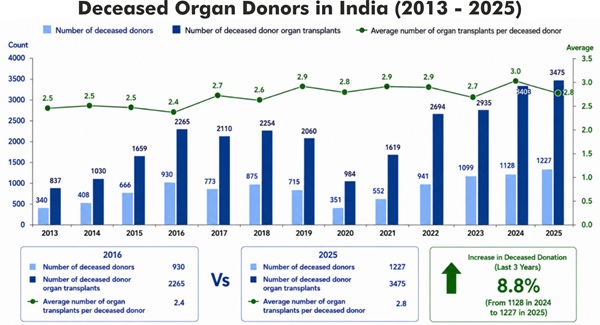
Over the last decade, India's deceased donor program has steadily grown. The number of deceased donors increased from 340 in 2013 to 1,227 in 2025, while total deceased donor organ transplants rose from 837 to 3,475 during the same period. This reflects a growing public awareness, better hospital networks, expanding transplant infrastructure, and stronger coordination systems. However, the deceased donation rate still stands at only about 0.9 per million population — far below many developed nations.
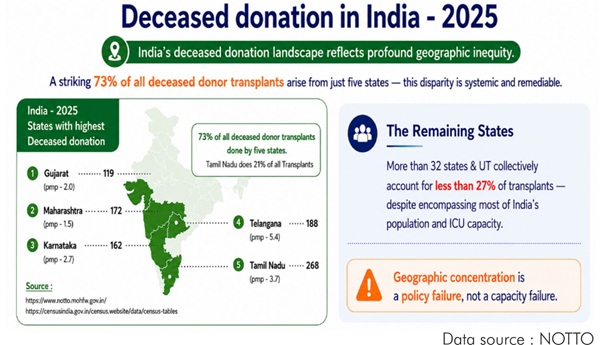
The bigger concern is the striking regional imbalance. Five states — Tamil Nadu, Telangana, Maharashtra, Gujarat, and Karnataka — account for nearly 73% of all deceased donor transplants in India. Tamil Nadu, in particular, has demonstrated how government leadership, transparent allocation systems, and public trust can build a successful donation ecosystem. Many other states continue to struggle with lack of leadership, reluctance among ICU clinicians to certify brain-death, poor awareness within the medical fraternity, lack of trained personnel and high dependence on living donor transplants.
In contrast, living organ transplantation is dominated by the Delhi/NCR region, which performs some of the highest numbers of living donor kidney and liver transplants in the country. This highlights a paradox: India possesses world-class transplant expertise, but access to deceased donor transplantation remains a geographical concern.
The next phase of India's transplant journey must focus on equity and expansion. Every state should develop robust organ donation networks, strengthen intensive care systems, train grief counsellors and transplant coordinators, and promote awareness both among the medical personnel and the public. Deceased donation is not merely a medical milestone — it is a measure of societal trust, compassion, and healthcare maturity.
To cite
: Shroff S. India's Uneven but Encouraging Progress in Deceased Organ Donation. Indian Transplant Newsletter. 2026 Jan-Mar; 25(1): p.1 and11.
DOI: 10.64384/ITN.2026.001
Available at:
https://www.itnnews.co.in/indian-transplant-newsletter/issue79/Indias-Uneven-but-Encouraging-Progress-in-Deceased-Organ-Donation-1440.htm
Available at:
https://www.itnnews.co.in/indian-transplant-newsletter/issue79/Indias-Uneven-but-Encouraging-Progress-in-Deceased-Organ-Donation-1440.htm
- Copyright © 2026. Published by MOHAN Foundation
