From Manipur to Tripura: MOHAN Foundation Partnering to Expand Deceased Organ Donation Across the Northeast
Pallavi Kumar, Vincent Debbarma
Indian Transplant Newsletter. 2025 Oct-Dec; 24(4): p8-9
DOI: https://doi.org/10.64384/ITN.2025.066
Print ISSN 0972 - 1568
Online ISSN 3048 - 653X
Download PDF
MOHAN Foundation's Journey with Tripura
Witnessing the success of the public–private–NGO partnership model in Manipur, the Government of Tripura extended an invitation to the MOHAN Foundation to support the state in initiating a deceased organ donation and transplantation programme.
Building a deceased organ donation and transplantation ecosystem is never the work of a single moment. It is built patiently-through trust, systems, awareness, and people. In Tripura, this journey is unfolding one institution and one community at a time.
State Engagement and Government Partnership
The groundwork was laid in January 2025, when a MOHAN Foundation team led by Dr Sunil Shroff (Managing Trustee), along with Ms Pallavi Kumar (Executive Director), Prof Deepak Gupta (AIIMS Delhi), and Ms Laishram Monica Devi (Programme Officer), visited the state in January 2025 at the invitation of the Hon'ble Chief Minister, Dr Manik Shah. The visit focused on supporting the Government of Tripura in initiating a deceased organ donation and transplantation programme through consultations, workshops, and high-level meetings.
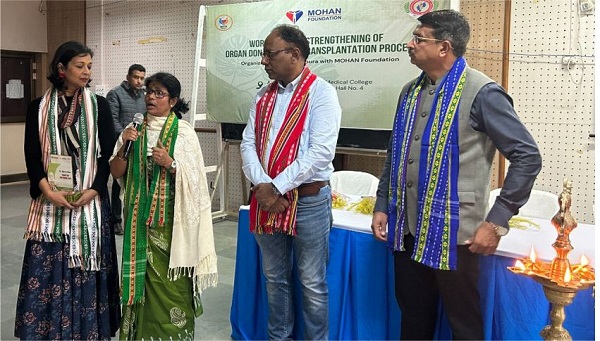
During the visit, Tripura hosted its first-ever workshop on deceased organ donation, “Strengthening Organ Donation & Transplantation.” Dr Sankar Chakraborti, Medical Superintendent, AGMC & GB Pant Hospital, highlighted the limitations of relying solely on living donor transplants and the urgent need for deceased donation. The Health Secretary, Government of Tripura, reaffirmed the state's commitment to expanding transplant services.
This was followed by a high-level meeting at the Chief Minister's War Room, chaired by Dr Manik Shah and attended by senior officials, including Shri Kiran Gitte, Secretary, Health & Family Welfare. The discussions concluded with strong governmental support—marking a critical first step toward a formal partnership.
Institutional Anchoring and Programme Set-up
In April 2025, the Foundation formalised its engagement through an MOU with Agartala Government Medical College (AGMC) & GB Pant Hospital, establishing the institutional base for the intervention. The first staff member was recruited in May 2025.
Between June 2025 and January 2026, this intent translated into action. In close partnership with the State Organ and Tissue Transplant Organization (SOTTO), Tripura, and AGMC & GBP Hospital, MOHAN Foundation undertook a focused phase of preparedness-centred on awareness, capacity building, system strengthening, and community engagement.
Public Awareness and Community Sensitisation
Public awareness formed the backbone of this effort. The first programme was held on June 26, 2025, at the Hepatitis Foundation of Tripura Nursing School, followed by a large sensitisation programme at AGMC & GBP Hospital. Over the months, awareness sessions expanded across medical, nursing, and paramedical institutions, schools, hospitals, rural blocks, police units, and community groups-reaching both urban Agartala and remote villages such as Sundortila and Fatikcherra.
Close to 30 institutions and communities had been engaged, reaching thousands of healthcare professionals, students, government staff, and members of the public. These sessions addressed myths, encouraged dialogue, and helped normalise conversations around death, donation, and dignity.
Healthcare System Preparedness and Capacity Building
Hospital preparedness was strengthened through repeated sensitisation sessions across departments at AGMC & GBP Hospital, covering clinical processes, counselling, coordination, and medico-legal responsibilities.
Media, Outreach, and Social Mobilisation
Community engagement extended beyond formal settings to public events, health camps, police trainings, and sporting platforms. A two-day football tournament in November 2025, attended by over 700 people, demonstrated how social mobilisation can carry life-saving messages. Radio and television programmes in Kokborok and Bengali ensured wider, culturally inclusive outreach.
Volunteer Development and Community Leadership
To build sustainability, a two-day Angels of Change volunteer training workshop was held in December 2025, creating a cadre of locally rooted advocates equipped to support awareness and counselling efforts.
Clinical Progress and First Deceased Donation Engagement
Alongside these efforts, clinical transplantation activity at AGMC & GBP Hospital progressed, with five living donor kidney transplants completed by December 2025. A defining moment came on November 19, 2025, when the MOHAN Foundation team responded to its first deceased donation call in the state. While eye donation could not proceed due to logistical constraints, sensitive counselling enabled the family to consent to body donation—reflecting readiness across systems, staff, and community understanding.
Looking Ahead: Laying the Foundation for Sustainability
Tripura's journey so far reflects the careful work of preparation. Awareness has been seeded. Systems have begun to align. Trust has been built.
Deceased organ donation programmes are not created overnight. They are built patiently—one state, one institution, one family at a time.
In Tripura, that journey has truly begun.
Poetic Justice in Tripura: Honouring a Family's Act of Courage
All organ donor families are special.
But families who say ‘Yes’ in states where donation programmes are still new-where they are among the first to lead the way and set a precedent-are truly extraordinary.
Recently in Agartala, Tripura, a state where donation behaviour is still evolving and where MOHAN Foundation has only recently begun its work, Ms Krishna Dhar, a school teacher, made the selfless decision to donate the whole body of her husband, Asim Bhushan, on November 19, 2025. Asim Bhushan, a small business owner, passed away at the age of 59 after battling kidney failure and undergoing dialysis.
Speaking about her husband, Ms Dhar shared with quiet pride, “He wasn't a very educated man, but his thinking was delicate and his thoughts were sublime.” She described the decision to donate his body as a form of poetic justice-a final act that reflected the goodness and kindness that defined his life. “He was a very, very good man,” she said, “and I don't have words to justify his kind nature.”
The couple had spoken earlier about body donation, believing deeply that one must give back to society. With the support of a MOHAN Foundation counsellor, Ms Dhar was able to honour her husband's wishes, amidst her grief. Her courage and clarity in that moment stand as a powerful testament to conviction and love.
Ms Krishna Dhar was felicitated by the Health Secretary of Tripura, Mr Kiran Gitte, at a programme jointly organised by MOHAN Foundation and SOTTO Tripura, in recognition of this selfless act.
These are not just acts of donation. They are acts of courage, generosity, and quiet leadership—gently expanding into what is possible for a state, and reminding all of us what humanity at its best truly looks like.
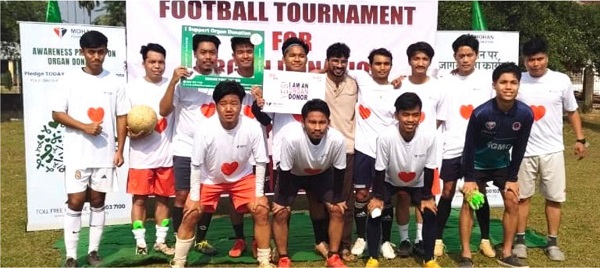
Awareness campaign at the football tournament
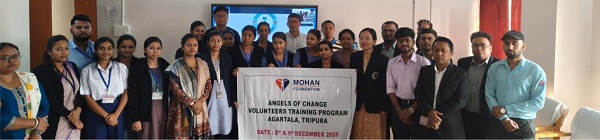
Participants at the 2 days training program on Angles of Change
To cite
: Kumar P, Debbarma V. From Manipur to Tripura: MOHAN Foundation Partnering to Expand Deceased Organ Donation Across the Northeast. Indian Transplant Newsletter. 2025 Oct-Dec; 24(4): p8-9.
DOI: 10.64384/ITN.2025.066
Available at:
https://www.itnnews.co.in/indian-transplant-newsletter/issue78/From-Manipur-to-Tripura-MOHAN-Foundation-Partnering-to-Expand-Deceased-Organ-Donation-Across-the-Northeast-1436.htm
Available at:
https://www.itnnews.co.in/indian-transplant-newsletter/issue78/From-Manipur-to-Tripura-MOHAN-Foundation-Partnering-to-Expand-Deceased-Organ-Donation-Across-the-Northeast-1436.htm
- Copyright © 2026. Published by MOHAN Foundation
