Deceased Donor Transplant Program – Best Practices from Tamil Nadu
Dr N Gopalakrishnan
Indian Transplant Newsletter. 2025 July-Sep; 24(3):p8
DOI: https://doi.org/10.64384/ITN.2025.051
Print ISSN 0972 - 1568
Online ISSN 3048 - 653X
Download PDF
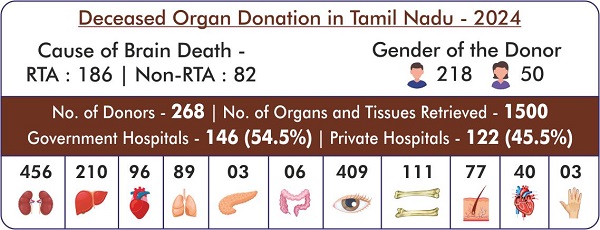
India's contingent ataTamil Nadu continues to lead the country both in deceased donation and deceased donor transplant program. Recent initiatives have strengthened the program, achieving a record of 268 deceased donors and 1,500 organs and tissues retrieved in 2024. Amid the complexity and diverse stakeholders involved– policy makers, bureaucracy, technocracy, media and the public, efforts have focused on integrating these domains cohesively.
Best practices adopted in the State in recent times
Honor Walk
In 2023, an honor walk was conducted, for the first time, at the Madras Medical College & Rajiv Gandhi Government General Hospital. A huge gathering including doctors, medical & nursing students, hospital staff and public participated in the honor walk. The donor family was overwhelmed with gratification and stated that such a gesture has lessened their agony. It received wide media coverage and sent ripples through all sections of society. Since then, in all the government institutions, ceremonial honor walk for the deceased donor has become a routine.
Honor by the State Government of Tamil Nadu
On October 7, 2023, the Government of Tamil Nadu issued an order (G.O. 331), mandating that state honors be accorded to deceased donors. The district collector or a high-rank district official will pay honors at the residence of the donor before final rites. So far, 461 state honors have been accorded. This first-of-its-kind Government Order has impacted the program substantially.
NTORC status for Government Institutions
The transplant program is available in 13 out of 36 government medical colleges in the state. The other medical college hospitals, though do not have adequate infrastructure to perform transplants, are equipped with intensive care unit managed by anesthetists/ intensivists. NTORC status was accorded to all these institutions along with five more district headquarters hospitals. This initiative proved to be a game changer, with NTORCs playing a key role in expanding the deceased donor program.
Training and Capacity Building Programs
To address doctors' concerns and build confidence, TRANSTAN has been periodically conducting two-and-a-half-day orientation programs covering brain death certification, medical management, and organ retrieval. In addition, TRANSTAN organizes periodic scientific sessions on various aspects of transplantation, both physically and virtually for donation and transplant professionals.
Appreciation from TRANSTAN
A personal note of appreciation is sent to the concerned institutions and transplant coordinators after every deceased donation. This simple gesture has been a source of encouragement for the concerned institutions and individuals.
Periodic Review
Performance of the deceased donor transplant program is reviewed periodically, at multiple levels – by the Director of Medical Education, Health Secretary and Honourable Health Minister. Such reviews provide greater impetus for the program.
Media
Both visual and print media have been extremely supportive to the program. Every donation is covered in the media. State honors accorded by the Collector is invariably covered with photographs.
Impact of the newer strategies
All these measures have proved of immense benefit. The program reached a newer zenith in 2024 with 268 deceased donors and 1500 organs and tissues retrieved and successfully utilized. Government hospitals led for the first time, contributing 54.5% compared to 45.5% from private hospitals. Deceased donations happened in 26 government institutions including remote colleges like Nilgiris Medical College. NTORCs made an impressive 43 donations accounting for 16% of the total donations.
Contribution from Private Sector Hospitals
There are quite a few centers of excellence in the private sector for heart, lung, pancreas and hand transplantation. A total of 146 private hospitals from all over the state are involved in transplant program. Through a memorandum of understanding (MOU), a private hospital benevolently provides hand-holding to develop liver transplant program in some government hospitals, without any financial benefits. Transplants for underprivileged patients are provided free of cost at empanelled private hospitals under the Chief Minister’s Comprehensive Health Insurance Scheme.
Accessibility
About 30.5% (264) organ transplants were availed by the economically underprivileged patients through the state’s health insurance scheme in 2024 and these patients were also supported with life-long immunosuppressive medicines free of charge.
Conclusion
The substantial progress that has been achieved in Tamil Nadu is due to the cohesive contribution and coordination of multiple stakeholders. TRANSTAN has been able to play the role of a conduit– connecting, facilitating, troubleshooting and encouraging all the domains of the program.
To cite
: Gopalakrishnan N. Deceased Donor Transplant Program – Best Practices from Tamil Nadu. Indian Transplant Newsletter. 2025 July-Sep; 24(3):p8.
DOI: 10.64384/ITN.2025.051
Available at:
https://www.itnnews.co.in/indian-transplant-newsletter/issue77/Deceased-Donor-Transplant-Program-Best-Practices-from-Tamil-Nadu-1421.htm
Available at:
https://www.itnnews.co.in/indian-transplant-newsletter/issue77/Deceased-Donor-Transplant-Program-Best-Practices-from-Tamil-Nadu-1421.htm
- Copyright © 2026. Published by MOHAN Foundation
