Beyond Forms and Files: Behavioural Insights Into Transplant Documentation
Sanjay Darshan Behera
Indian Transplant Newsletter. 2025 July-Sep; 24(3):p10-11
DOI: https://doi.org/10.64384/ITN.2025.054
Print ISSN 0972 - 1568
Online ISSN 3048 - 653X
Download PDF
Introduction
The quality of documentation in living-donor transplantation is often seen as a matter of compliance, the ability to complete forms accurately, attach supporting evidence, and present the case to an Authorisation Committee (AC) for approval. Yet, at its core, documentation is an act of communication. It reflects how well the Transplant Coordinator (TC) interprets human interactions, motives, and emotions. The frameworks of Organisational Behaviour (OB), Transactional Analysis (TA), and the Johari Window illuminate this dimension, turning documentation from a mechanical process into a disciplined expression of ethical clarity and professional judgement.
The Behavioural Foundations of Clarity
The transplant environment is complex. Donors may be anxious, recipients may be desperate, and both operate within a system of intense scrutiny. The TC functions as the interpreter of intent, translating human motivations into administrative clarity. Here, behavioural science offers the lens through which precision and empathy can coexist.
From an OB standpoint, clarity arises not merely from correct data entry but from shared understanding. The AC does not judge the case file as a pile of forms; it perceives it as a story about two individuals and a system that must ensure voluntariness and fairness. Thus, clarity must be behavioural as much as factual.
TA: The Compass for Communication
TA, developed by Eric Berne, views every human interaction as a transaction between ego states: Parent, Adult, and Child. In the transplant setting, the TC's effectiveness hinges on maintaining an Adult-to-Adult dialogue, where facts are verified calmly and emotions are acknowledged without letting them dominate.
A donor operating from a Child ego state might express guilt, dependence, or fear: “My brother insisted; I had no choice”. Responding from the Parent ego state, with authority or moral judgement, risks reinforcing anxiety. Instead, the TC should respond from the Adult ego state: objective, composed, and empathetic. A measured response such as “Let's go over how you reached this decision together, step by step” helps restore equilibrium and invites rational discussion.
Occasionally, a Supportive-Parent tone, which validates the emotions of the donor before redirecting the discussion, is useful. For instance, if a donor expresses guilt or fear, the TC can acknowledge these feelings before guiding the conversation back to the facts. Yet the TC must always return to the Adult stance, because documentation derived from an emotionally charged exchange can distort meaning. Each counselling note or consent record must thus reflect balance, compassion without advocacy, precision without rigidity.
The Johari Window: Unearthing the Hidden Quadrant
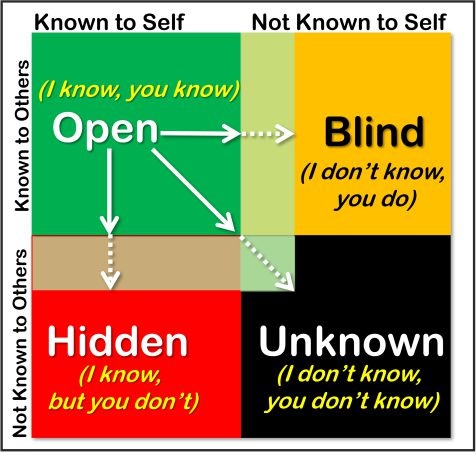
Where TA manages the tone of interaction, the Johari Window, developed by Joseph Luft and Harrington Ingham, clarifies awareness within communication. It divides information into four quadrants: Open, Hidden, Blind, and Unknown; each representing the visibility of knowledge shared between two or more people. In the context of transplant counselling, these quadrants mirror the psychological windows through which the donor, recipient, and TC view the truth of their situation.
For a TC, expanding the Open (I know, you know) area is easy to infer, can be enlarged by empathy, confidentiality, and neutrality, and is the foundation of ethical clarity, helping reduce the size of the other quadrants. Encouraging openness through empathetic but purposeful questions helps move information from concealment into documentation. For instance, a donor who hesitates to admit financial dependence on the recipient's family may gradually open up when the TC frames the inquiry with sensitivity: “It is important for us to understand if anyone is supporting you financially during this period”. Each such conversation transforms implicit understanding into an explicit record.
However, the quadrant most relevant, and potentially perilous, in living donor transplantation is the Hidden (I know, but you don't) quadrant. This represents what the donor and recipient know between themselves but conceal from the TC and the system. In an ecosystem occasionally marred by incidents of coercion or commercial influence, this hidden zone may contain the real motivations, unspoken obligations, or financial arrangements that never surface unless probed with skill. Left unexplored, it can allow the appearance of voluntariness to mask underlying exploitation.
The TC's foremost challenge, therefore, is to unearth the Hidden quadrant without confrontation. This requires a delicate balance between empathy and vigilance. Gentle probing, indirect questioning, and cross-verification help surface inconsistencies without creating defensiveness. Hesitations, short answers, and avoidance of eye contact indicate hidden area information. For instance, a donor may say, “He's been like a brother to me for years”, while documents show no traceable relationship. Here, the TC's role is not to accuse but to explore, bridging the hidden area into the open one by facilitating reflection and verification; “That's a warm bond; could you tell me when you first met and how your families are connected?” Each such step shifts the narrative from assumption to substantiation.
The Blind (I don't know, but you do) quadrant represents what the TC perceives but the donor may be unaware of, like subtle mannerisms, tone, or behavioural cues. These cues are secondary indicators that may point towards the deeper Hidden quadrant, where information is consciously withheld. For instance, avoidance of eye contact, over-rehearsed answers, or repeated reference to another person's authority (“He will explain better”) are behaviours that the donor may not recognise as revealing, yet they can alert the TC to possible coaching, anxiety, or lack of autonomy. Such signals should be documented objectively, for example, “Donor sought repeated validation from recipient during session; follow-up planned separately”.
In addition, the Unknown (I don't know, you don't know) quadrant, what neither the donor–recipient pair nor the TC is consciously aware of, also plays a quiet but significant role. It encompasses the latent emotions, unexamined motivations, or family influences that even the individuals themselves may not fully recognise. While the TC cannot directly uncover this domain, awareness that such a layer exists encourages humility and attentiveness. A calm, reflective approach, allowing pauses and space for self-expression, often enables such unspoken realities to surface naturally. Recognising the limits of one's insight is itself a form of professional wisdom, reminding the TC that not every truth can be forced, but many can be gently discovered.
Ultimately, the Johari Window reminds coordinators that documentation is never neutral. It is shaped by what both parties choose to reveal or conceal. Using the Johari Window technique, the idea is to gently move relevant details from the hidden/blind quadrant into the open quadrant and expand the open quadrant. Expanding the shared space of understanding is therefore the moral and practical aim of every counselling session.
OB and the TC's Professional Identity
From an OB perspective, the transplant system is a miniature organisation with interdependent stakeholders, TCs, clinicians, administrators, and AC, each with distinct roles, expectations, and power dynamics. The TC operates at the intersection of all these relationships. Their credibility is evaluated not only by accuracy but also by how consistently they exhibit professional behaviour: composure under pressure, balanced reporting, and respect for procedure. The OB lens situates the TC as a “boundary spanner”, mediating between the human and administrative worlds. The success of this mediation depends on emotional intelligence - self-awareness, empathy, and impulse control.
Behavioural frameworks also inform institutional trust. AC members, accustomed to evaluating complex ethical cases, develop perceptions of a TC's reliability over time. A coordinator known for neutrality and disciplined documentation earns quicker acceptance of their assessments. Conversely, patterns of copy-paste errors or inconsistent phrasing trigger suspicion, regardless of the case's merit.
Counselling: The Crucible of Ethical Clarity
Counselling sessions between the TC, donor, and recipient are the heart of the documentation process. They are not therapeutic dialogues but structured inquiries to establish voluntariness, comprehension, and authenticity. Behavioural science transforms these sessions from check-box exercises into moments of ethical engagement.
TA and the Johari Window guide how questions are asked and how responses are interpreted. A funnel approach, moving from broad narratives to specific verifications, uncovers layers of motivation without intimidation. The TC observes tone, hesitation, and alignment between verbal and non-verbal cues, recording facts rather than impressions. When uncertainty persists, a follow-up session after an overnight interval allows reflection and reduces the influence of immediate emotional pressure on the donor-recipient.
Documentation of these interactions must be precise, including dates, participants, the language used, and the translator's credentials. Every recorded line should survive scrutiny. Behavioural discipline ensures that the written record is not an echo of the TC's bias but an accurate reflection of the conversation's substance.
Behavioural Discipline as Professional Ethic
At its deepest level, integrating TA, the Johari Window, and OB principles instils a behavioural discipline that transcends technical skill. It teaches TCs to recognise their own biases, manage interactions with composure, and document with reflective precision.
In TA terms, professionalism is the consistent practice of the Adult ego state under stress. In the Johari framework, professionalism is the effort to expand the Open area through transparency and feedback. From an OB perspective, professionalism sustains organisational credibility; each coordinator's behaviour contributes to the institution's collective reputation.
This triad of frameworks builds resilience against burnout and ethical drift. It reminds TCs that their work is not clerical but moral: they safeguard the donor's dignity, the recipient's hope, and the system's trust.
Closing Reflection
Documentation is more than a record; it is a reflection of behaviour, ethics, and empathy. When TCs apply behavioural science with attentiveness and discipline, they transform the transplant documentation process into an affirmation of trust, a bridge between human intention and institutional integrity.
References
1. Berne E. Transactional analysis: a new and effective method of group therapy. Am J Psychother. 1958 Oct;12(4):735-43. doi: 10.1176/appi.psychotherapy.1958.12.4.735. PMID: 13583264.
2. Luft J. The Johari window: A graphic model of awareness in interpersonal relations. Accessed at https://ombuds.columbia.edu/sites/ombuds. columbia.edu/files/content/pics/30%20Anniv/The%20Johari%20window_A%20graphic%20model%20of%20awareness%20in%20interpersonal%20relations.pdf
3. Rahman H, Kodikal R. Understanding transactional analysis of managers: An empirical study in India. Probl Perspect Manag. 2020;18(1):157-67. doi: 10.21511/ppm.18(1).2020.13.
4. Mukherjee D, Pahwa V, Moza B, et al. The influence of personality traits on Johari window perception and self-disclosure in the workplace. IP Int J Forensic Med Toxicol Sci. 2023;8(2):100-7. doi: 10.18231/j.ijfmts.2023.022.
5. Arjmandmazidi S, Heidari HR, Ghasemnejad T, et al. An in-depth overview of artificial intelligence (AI) tool utilisation across diverse phases of organ transplantation. J Transl Med. 2025;23:678. doi: 10.1186/s12967-025-06488-1.
To cite
: Behera S D. Beyond Forms and Files: Behavioural Insights Into Transplant Documentation. Indian Transplant Newsletter. 2025 July-Sep; 24(3):p10-11.
DOI: 10.64384/ITN.2025.054
Available at:
https://www.itnnews.co.in/indian-transplant-newsletter/issue77/Beyond-Forms-and-Files-Behavioural-Insights-Into-Transplant-Documentation-1424.htm
Available at:
https://www.itnnews.co.in/indian-transplant-newsletter/issue77/Beyond-Forms-and-Files-Behavioural-Insights-Into-Transplant-Documentation-1424.htm
- Copyright © 2026. Published by MOHAN Foundation
